


Rome
The tour begins in Piazza Venezia, the vibrant heart of modern Rome. Amid the grandeur of the Vittoriano monument and the city's hustle and bustle, stands Madama Lucrezia, one of Rome’s famous “talking statues,” near the staircase of Palazzo Venezia. Some believe she represents the ancient goddess Isis—a silent witness to the profound connection between Rome and Egypt.
A short walk away, in the Campo Marzio district, once stood the Iseum Campense, the largest Roman sanctuary dedicated to Egyptian deities. Originally built during the late Republic and expanded under Caligula and Domitian, the sanctuary spanned a vast area adorned with sphinxes, statues, and authentic obelisks—some of which, like the one now standing in Piazza Navona, were originally erected here. Today, remnants of the Iseum can still be seen along Via di San Stefano del Cacco and inside the recently reopened Iseum Museum, which is included in the visit.
Continuing toward Piazza della Pigna, even the name recalls its ancient past: the "pigna," or large bronze pinecone, once likely decorated a sacred space linked to the Iseum and is now preserved in the Vatican Gardens. The pinecone—an ancient symbol of rebirth and immortality—held deep meaning in Egyptian spirituality as well.
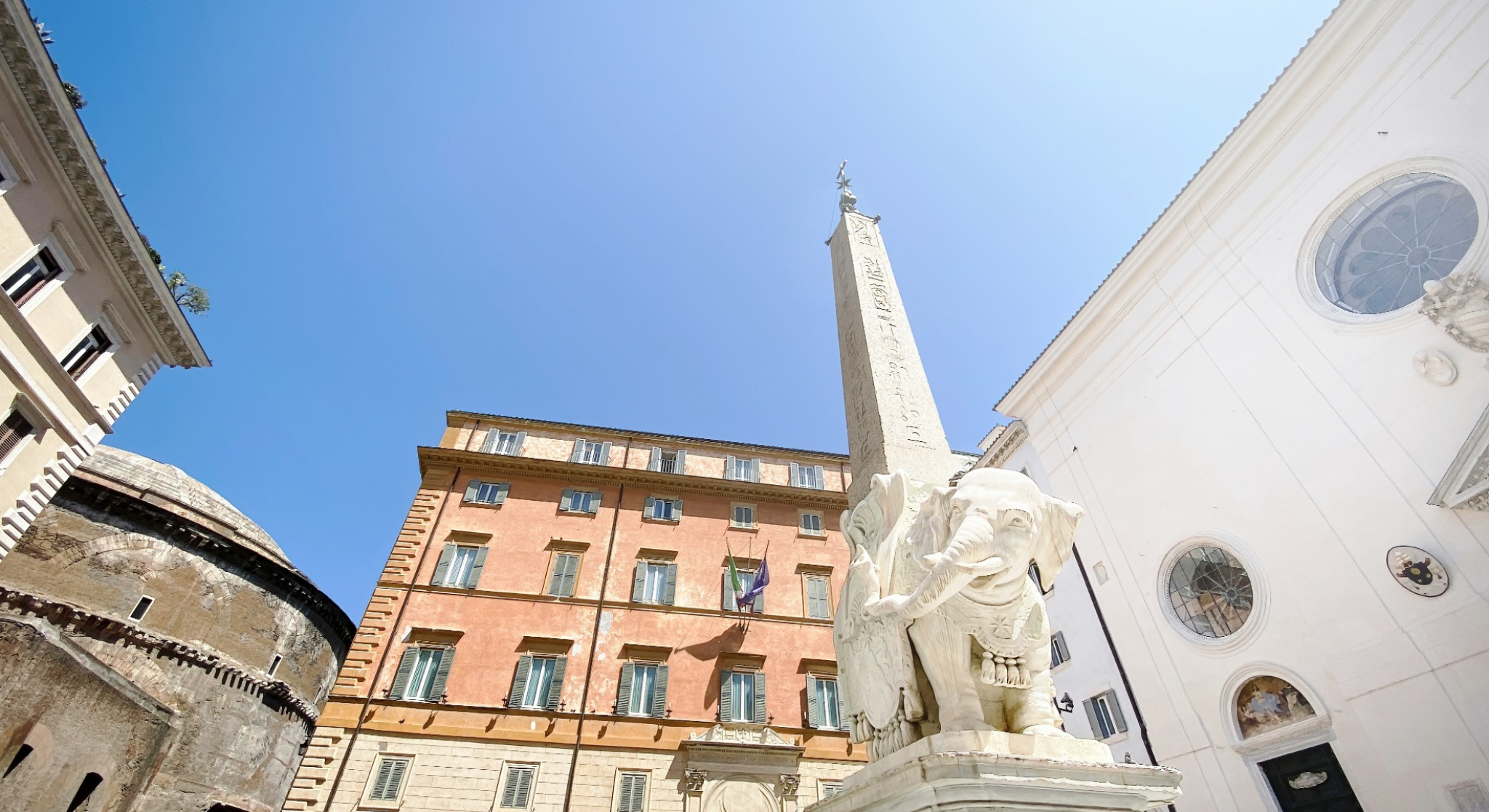
The journey proceeds to Piazza della Minerva, where antiquity and Baroque artistry merge. Here stands a small Egyptian obelisk, carried on the back of an elephant sculpted by Bernini, just in front of the church of Santa Maria sopra Minerva. This obelisk, also from the Iseum, serves as a mystical symbol of ancient knowledge—perfectly aligned with the esoteric cult of Isis.
A few steps away is the Pantheon, where another obelisk rises in the square. Originally from the Temple of the Sun in Heliopolis, its modern placement aligns with the Pantheon’s dome, reflecting an ancient cosmic harmony—between heaven and earth, mythology and science.
Near Piazza San Luigi dei Francesi, archaeological excavations have revealed fragments of yet another buried Egyptian obelisk, further evidence of the enduring influence of the Isis cult in ancient Campo Marzio. Nearby, in Piazza di Sant’Eustachio, stands a Baroque fountain featuring a basin carved from Egyptian granite, once part of the Neronian-Alexandrian baths—a tangible remnant of Imperial Egypt in the heart of Rome.
The tour concludes at the spectacular Piazza Navona, where Bernini’s Fountain of the Four Rivers is crowned by a 17-meter pink granite obelisk from Aswan. Brought to Rome by Emperor Domitian and inscribed with hieroglyphs in honor of his divine status, this obelisk once stood between the temples of Isis and Serapis. Today, it rises above the Baroque splendor of the square, offering a powerful finale that blends the sacred, the artistic, and the imperial.